

Trip Highlights
*Please note that the following information is meant to provide a general overview of your tour. The specifics of your trip will be contained in a pre-trip letter you will receive prior to your confirmed departure.*
Important Trip Details:
SEA KAYAKING PORTION:
MEETING PLACE: Hacienda Suites, Loreto
MEETING TIME: Day 0, 6:00 PM MST
TRIP MILES: Varies depending on group size, weather and kayaker's abilities
PUT-IN: Puerto Escondido, 20 miles south of Loreto in Sea of Cortez
TAKE-OUT: Puerto Escondido, 20 miles south of Loreto in Sea of Cortez
RETURN TIME: Day 5 between 2:00- 3:00 PM MST
TRIP LENGTH: 5 days
AGE LIMIT: Recommended age is 9
BOAT TYPE: Kayak
THE LAST SUPPER: Join your guide and fellow trip guests for a no host farewell dinner at a favorite local restaurant.
NEAREST AIRPORTS: Loreto International Airport (LTO)
BLUE & FIN WHALE PORTION:
MEETING PLACE: Loreto Marina by the Lighthouse
MEETING TIME: 8:00 AM
WHALE WATCHING PORTION:
MEETING PLACE: Hacienda Suites, Loreto
TRIP MILES: 2-hour drive from Loreto to Lopez Mateos Marina on the Pacific Ocean.
PUT-IN: Panga boat ferry from Lopez Mateos Marina to Madalena Bay Whale Camp
TAKE-OUT: Lopez Mateos Marina on the Pacific Ocean
RETURN TIME: Day 9 around 2:00 PM MST
TRIP LENGTH: 3 days
AGE LIMIT: Recommended age is 8
BOAT TYPE: Panga Motor Boat
Sample Itinerary
Day 0: Arrive in Loreto, Evening Orientation Meeting
Upon your arrival in Loreto, served with nonstop flights on Alaska and American Airlines, as well as twice weekly flights from Guadalajara, you can grab a taxi for a short ride to the recommended tour hotel. Spend your afternoon exploring the historic town of Loreto, where cobbled streets and palm trees create a relaxed atmosphere. Visit the old mission in the center of town, the small marina, the pedestrian walkway lined with shops, bars and restaurants and enjoy some tasty Mexican cuisine before meeting your guides for an evening orientation meeting.
See our Baja Travel Guide for tips on getting to and from Loreto.
Note: If you want to add another day of adventure to your time in Baja, arrive a day or two early and sign up for a chance to see sea lions on a Skiff and Snorkel tour on Isla Corodano, or explore Baja’s interior on a hiking tour of Steinbeck Canyon!
- Accommodation: Not Included
Day 1-4: Sea Kayaking the Islands of Loreto Bay
This morning after breakfast at the hotel you set out into the island-studded waters of Loreto Bay National Marine Park, where rugged volcanic islands rise from the Sea of Cortez and marine life is never far away. Over the next several days, you'll paddle along dramatic shorelines, explore hidden coves, and move between remote beach camps surrounded by some of Baja's most spectacular scenery.
Each day blends active exploration with time to slow down and enjoy the rhythm of island life. Snorkel in clear waters, search for dolphins and seabirds, wander desert trails, or simply relax on the beach between paddling sessions. Depending on conditions, you'll explore the coastlines of islands such as Danzante and Carmen, with flexible routing designed to take advantage of the best weather and wildlife opportunities.
Evenings are spent camped beside the sea, enjoying freshly prepared meals, colorful sunsets, and star-filled skies that seem to stretch forever overhead
- Accommodation: Beach Camping
- Meals Included: Breakfast (not included on day 1), Lunch, Dinner
Day 5: Final Paddle & Return to Loreto
Enjoy one last morning on the islands before packing up camp and setting out for your final paddle. Back on the mainland, enjoy lunch with your guides before returning to Loreto in the afternoon.
- Accommodation: Not Included
- Meals Included: Breakfast, Lunch
Day 6: Blue Whale Watching in Loreto Bay National Marine Park
Arrive at the Loreto Marina this morning and meet your guides for a full day exploring the wildlife-rich waters of Loreto Bay National Marine Park, a UNESCO World Heritage Site and one of the best places in the world to search for blue and fin whales.
Board a small boat and head into the waters surrounding the islands, keeping watch for the world's largest animal, the blue whale, as well as fin whales, dolphins, sea lions, and other marine life that frequent these productive waters. Your guides will share insights into the area's unique ecology and the remarkable migrations that bring these giants to Baja each winter.
Midday, step ashore for a picnic lunch and time to stretch your legs before returning to the water for an afternoon of wildlife viewing. By late afternoon, return to Loreto with a deeper appreciation for the incredible marine ecosystem you'll soon be exploring by kayak
- Accommodation: Hacienda Suites
- Meals Included: Continental Hotel Breakfast, Lunch
Day 7: Loreto to Magdalena Bay
We leave early to travel west across the Baja Peninsula from Loreto to Magdalena Bay, your home for the next two nights. From the village of Lopez Mateos we take a panga (motorboat) for a two-hour whale watching session while also traveling in the direction of our camp located on a sand-dune island. With luck, we’ll see our first gray whales swimming in the calm waters, or in the choppy surf at the ‘boca’ or mouth of the bay. By noon we’re at our camp. Settle into your comfortable stand-up canvas tent before we sit down for lunch by the sea. After lunch our guides lead a walk across the island, speaking to the island’s diversity of flora and fauna.
There’s time to beachcomb and relax to the sound of crashing waves on the western side of the island. We walk back along the shoreline to the protected east side where our camp is located. Before long, it’s time for appetizers and our naturalist-led presentation about whale biology. Soon after the sun sets and the cool Pacific air moves in. Dinner is served outside on the beach or inside our community dome tent, depending on weather. Soon it’s time for bed. Each tent has two cots with sleeping pads and warm sleeping bags, liners and pillows. They are set within the dunes of the island in a lovely, organic way with views of the sea
- Accommodation: Island camping in stand-up height canvas tents
- Meals Included: Lunch, Dinner
Day 8: Whale Watching in Magdalena Bay
Sunrise awaits early risers, with a hot beverage on the shores of the island where you will likely see dolphins or whales swimming in the distance, or even up close. Our camp has the most idyllic location of any in Baja as the waters in front of camp are deep enough for whales. Soon it’s time for breakfast, then our pangas arrive for the morning whale watching session. With no more than 6-7 guests per boat, plus our naturalist guide to lead the way, this is an intimate whale watching experience. We sometimes encounter playful males in the open waters by the mouth of the bay. Or we may find mothers and calves resting in the calm waters of the lagoon. Being in the salty fresh air is always invigorating. After our morning session we return to camp for lunch and some rest, or a walk. Mid-afternoon we head out for another two-hour whale watching session. We sometimes spend an hour or so of this session in the nearby mangroves in order to observe the area’s vibrant birdlife.
At camp again we enjoy another presentation by our naturalist guides. Some have degrees in marine biology while others grew up in local fishing villages and gained their knowledge through a life of fishing, clam digging and time on and in the sea. Our cook prepares hors d’oeuvres and dinner soon after the sun has set. Another restful night at camp.
- Accommodation: Island camping in stand-up height canvas tents
- Meals Included: Breakfast, Lunch, Dinner
Day 9: Magdalena Bay to Loreto
After breakfast pack up your gear because today we load it into the whale watching pangas and spend two hours watching whales as we also travel slowly south to Adolfo Lopez Mateos town, where we launched a few days ago. We’re well liked in this town as our trips bring much economic benefit to the people that live here. They drive our whale watching pangas, work in our camp and sell us supplies. We enjoy lunch at the local fishing cooperative restaurant and then board our van to head back to Loreto.
This evening, gather with your fellow paddlers for an optional farewell dinner in town and celebrate an unforgettable week exploring Baja California Sur.
- Accommodation: Hacienda Suites
- Meals Included: Breakfast, Lunch
Day 10: Departure
Your adventure concludes in Loreto today. Depart at your convenience or choose to extend your stay and enjoy more time exploring Baja California Sur.
- Accommodation: None
Wildlife Encounters
We are passionate about offering our guests the chance to experience the natural beauty of wildlife in its most authentic form—wild and free. While our sea kayaking and whale watching tours explore regions rich with diverse marine life, it’s important to understand that these encounters are always on nature’s terms. Wildlife sightings are unpredictable and unplanned, which is part of their enchantment and wonder. We cannot guarantee specific sightings or interactions, as each trip holds its own unique discoveries. The thrill of the unexpected and the privilege of observing animals in their natural habitat makes each journey special. Our guides are dedicated to enhancing your understanding of the ecosystems we visit, making every experience a meaningful one, regardless of what wildlife we may or may not encounter. Thank you for joining us with an open mind and an adventurous spirit as we celebrate the wonder of wild places.
Travel Arrangements
Please see our Baja Travel Guide for full details on travel to and from Baja.
Weather
Baja has a desert climate. The weather is typically dry, warm, and sunny, with temperatures ranging between 60 - 90 F (15 - 32 C). While it may be very warm during the day, temperatures can drop down to the 60’s during the evening hours. Please plan to pack appropriate layers for the evenings.
If you are interested in more specific information regarding the weather in Baja, we highly suggest this website; wunderground. If you put in the location you are traveling, and the date, it will provide you with historical weather data that you can use to plan for your upcoming adventure.
WHEN TO GO?
For many people, the best time to go is the time that fits their vacation, or when they want to escape the chill of winter in the north. Here's some other information to help you decide what would be the best time to go in order to meet your expectations and desires.
Baja weather is much more mild than many places in North America, but it is still in North America, as it is north of the equator, and does have all four seasons. The summer months of June through August are blistering hot and rather humid in Baja California Sur. It's a time that sport-fishers and a few other tourists come, but it's not peak season due to the heat. All the summer heat has the benefit of heating up the sea and that is appealing to people that love warm water. As the weather cools down in September and we begin our kayaking and tour season in October, the water holds that heat and the Gulf of California is wonderfully warm. If your dream is hot weather and warm water, then October through mid November is a great time to visit Baja. By early December the seas have cooled somewhat and daytime temperatures are lower. It's not cold by any means, but it's not hot either. Days are generally in the 70's (20’s C) and nights in the 60's. Clear blue skies and sunshine can make it feel warmer of course, but these are the true temperatures. We go snorkeling, but as water temperatures are in the 60's (15 C), most people wear the wetsuits that we provide.
Winds are also a factor in Baja. The Gulf of California is less windy in October, November, and mid-March through the summer, than it is in December through February. That's why some of our trips, like Isla San Jose, are only offered during the less windy timeframes because of logistics and the orientation of the islands. Be aware that your trip may be altered by wind conditions at any time, but it's more likely to be an issue in the December through February timeframe.
Compared to much of North America, Baja weather is idyllic. Even the coldest day in Baja is mighty nice! With the proper clothing and expectations, it's always the "best" time to be in Baja! But consider your wishes and the experience you want to have when deciding when to go. Always feel welcome to contact our staff if you have questions.
Getting Ready
Sea Kayak Adventures Physical Requirements
Here at Sea Kayak Adventures our first and foremost goal is for you to have an enjoyable and safe experience. While most of our trips are suitable for beginners, some of our trips are more active than others and it’s important that you understand the physical requirement of the trip you choose.
All of our sea kayaking trips are active adventures that involve some level of physical exertion and possible exposure to the elements including but not limited to wind, rain, heat, sun, cold temperatures and cold water conditions. Sea Kayak Adventures is able to accommodate people with physical limitations, disabilities and medical conditions; please speak with your Adventure Consultant if you think you will require any additional assistance while on the trip. We ask that you consult your Doctor if you have health or medical conditions that could impact your ability to participate in an active and outdoor adventure. In general, all trip participants must be able to do the following:
- Wear all protective and safety equipment that are required by Sea Kayak Adventures and recommended/required by industry wide standards.
- Load and unload, on their own or with the aid of a qualified companion, the bus and/or van providing transportation for Sea Kayak Adventures activities.
- Reach the water access points (put-in and take-out) on their own, or with the aid of a qualified companion.
- Enter and exit the raft, kayak and/or inflatable kayak on their own or with the aid of a qualified companion.
- Remain seated and balanced in a floating raft, canoe, kayak or inflatable kayak w/ the aid of adaptive equipment, if necessary.
- Float on their back when entering moving and still water. The participant must be capable of turning from face-down to face-up in the water with the aid of a Personal Floatation Device and must be able to hold their breath while under water.
- Remain calm and keep breathing under control in the event of a swim.
- Climb into the kayak, with the help of another person, should an involuntary swim happen at any point on the water.
- Make progress toward the shoreline or a boat by swimming in moving water and must be able to exit the water and ascend the shoreline once reached.
- Participate as an active paddler when instructed by the guide for the duration of trip.
- Move about the campsite on their own or with the aid of a qualified companion on all trips that include overnight camping and/or lunch.
Physical Preparedness
Whether you are an avid sea kayaker, or it is your first time, you’ll enjoy these incredible trips, and share in our passion for adventure, commitment to conserving the environment, and relishing unique experiences. For those new to the sport, kayaking is easy to learn in the sheltered waters that we visit, and we provide all of the camping gear, kayaking equipment and guidance needed. In addition, we keep our groups small to allow you to not only travel intimately among nature, but to ensure you receive the necessary attention from our guides.
Packing List
Baja Sea Kayaking + Whale Watching Packing List Overview
The packing list outlined below is meant to serve as a guide to help you plan, prepare and outfit yourself for your upcoming travels. We have provided our best recommendations and suggestions. These suggestions are broken down by your tour type and are based on the outlined itinerary, the geographic region, our knowledge of Baja, and our personal experience. We hope you find this list helpful, use it as a guide and feel free to amend it with your favorite travel items too!
Our whale camp is located on an island on the Pacific Coast side of Baja. At times it is quite a bit cooler on the Pacific side than the Gulf of California side. Fog and mist are common. When out in the pangas (motorboats) for whale watching, it can be windy and cool. If you’re lucky and the sun is out during the day you will need to focus on sun-protection. However, evenings are always cool and the weather is highly variable. Thus, be sure to pay attention to our recommendations about cold-weather gear.
Gear Provided by Sea Kayak Adventures
Sea Kayak Adventures provides all necessary equipment for your selected tour. This includes all necessary camping equipment for your tour: tent, sleeping pad, sleeping bag, sleeping bag liner, and pillow with pillow case. We also provide all necessary kayak gear including personal flotation devices (PFDs), paddles, kayaks, and three dry bags. We provide masks, snorkels, fins and wetsuits. *Please note if you wear eyeglasses you should bring your own mask to accommodate those or your own prescription lens mask. Our wetsuits are a mix of short legs and full length legs and we will provide one for you, but can't guarantee if it will be long or short legged.
Provided Dry Bags
At the orientation meeting the evening before your tour, we will provide you with three dry bags: two 20-liter bags and one 10-liter bag. These bags are designed to keep your personal items waterproof and are easier to store within the kayaks than standard luggage. Your guides will provide a full explanation on how to pack and use the bags. That evening, you will pack all the gear required for your tour into these three bags. The 10-liter bag is best for items you may need throughout the day, as it can be stowed in the cockpit with you or in a storage compartment in the bow or stern. The larger 20-liter bags are intended for your clothing and will also be stowed in the storage compartments of your kayak. Note: your sleeping equipment—including your sleeping bag, liner, pad, and pillow—will be packed separately.
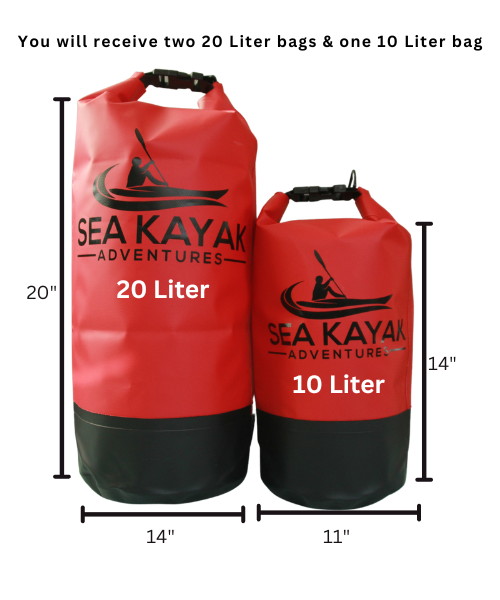
If you have extra luggage, it can be left at the hotel where you stay. If you do not stay at our recommended trip hotel be sure to check with the place you do stay.
Provided Snorkeling Attire
We will provide you with a shorty wetsuit, snorkel mask, fins, and PFD.
Luggage Recommendations
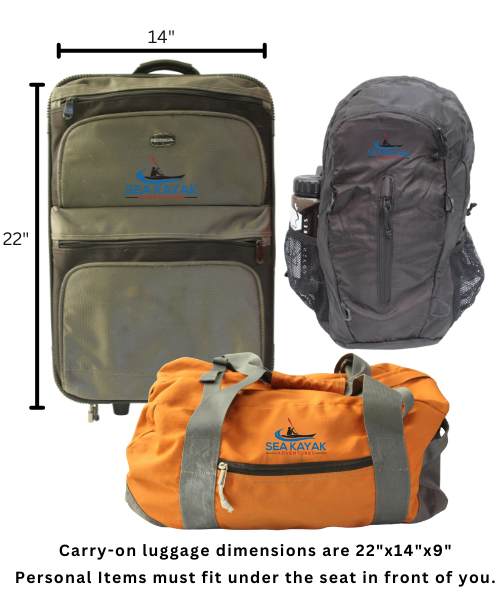
Sea Kayak Adventures are best enjoyed if you travel light. We think it is wise to avoid checking any luggage under the plane. If you do check a bag, make sure that you have everything that is either essential or would be hard to replace, with you in your carry-on/ personal item.
Use Soft Sided Luggage
We do not use dry bags for our Whale Camp tours. We suggest using soft sided luggage for your main bag. Since we do not use dry bags for whale camp; your bag will accompany you to our Whale Camp, where it will be transported by Van and Panga. Using soft sided luggage will make this transfer easier. This will serve as your main piece of luggage for the trip. During your kayaking portion of your combo trip, you will be able to store your extra luggage at the hotel since you will be using dry bags. In addition, if you do have a checked bag you can leave luggage behind in storage at your tour hotel during your whale watching tour & kayak tour.
One Small Day Pack
This dual purpose pack can serve as your personal item during your flights as well as your day pack during the whale camp portion of your tour. Outside zippered pockets are nice and allow you to organize your travel gear. Carry medications, travel documents, important personal items and other essentials or “hard-to-replace” items in this on the plane.
Baja Sea Kayaking + Whale Watching Packing List
Essential Items
- Passport – please check that the expiration if valid for the destination you are traveling to.
- A photo of your passport on your phone. A photocopy of your passport, inside a ziplock bag and stowed elsewhere in your luggage. (As an additional precautionary measure, consider leaving a photocopy with family or friends at home as well.)
- Copy of your air tickets with ticket numbers, placed elsewhere in your luggage and/or email someone back home your air ticket information in case you lose your phone.
- Credit and/or Debit/ATM card that works internationally, ideally with chip technology (Some banks want you to notify them of travel plans ahead of time which often can be done online.) In Loreto there are two banks where you can get pesos using your ATM debit card. The one with the best rate is Banco Azteca.
- Plan to use cash (pesos) for small purchases, taxis and incidental tipping
- USD, CAD or Euros for guide gratuities at the end of your trip
- Watch or small travel clock with alarm (if you are taking a phone, this can serve as your alarm clock)
- Money belt or concealed passport carrier to carry your passport, travel documents and money, hidden under your clothing
- TSA-accessible lock for luggage security when not on your person (optional- can buy these at any travel or outdoor recreation store)
Adventure Clothing
We highly suggest that all of your kayak clothing is synthetic or wool, not cotton. Synthetics are also ideal for activity, as they wick away moisture from the body and dry quickly. (Added SPF protection in your clothing is always a great option for Baja). We recommend keeping one outfit out of the following packing guidelines as a “post activity” outfit for mornings and nights at camp. The evenings and early mornings can be chilly at whale camp, therefore packing according to this list is important.
- One - three pair long, lightweight, nylon pants with zipper pockets (zip off legs give you more options)
- One pair of nylon shorts
- Swimsuit
- Rashguard - great for use as sun-protection and extra warmth when snorkeling
- Sarong (optional, but super handy for changing clothes, laying on the ground, etc.)
- One windbreaker or light raincoat (better) that truly stops wind, for use on the pangas when whale watching
- One - three short sleeve button-up shirt(s) or t-shirt(s) (synthetic is best)
- One - three long sleeve shirts, ideally with SPF protection
- One light-weight bottom layer like a long-sleeve synthetic shirt or merino wool t-shirt
- One medium-weight layer of fleece - synthetic or merino wool for warmth
- One heavier-weight layer of fleece OR a "puffy jacket" of synthetic down
- Underwear
- One wide-brim, tie-on hat
- Three pair light synthetic or merino wool socks
- One pair sturdy trail shoes, or running shoes, to use for hiking and for casual camp time. They will get sandy at camp
- One pair of sandals with ankle straps to wear while kayaking, on the beaches, walking around towns, etc.
- One buff - for sun protection as well as wind protection on cold days
- One warm beanie cap or ski cap (especially important on whale watching trips and November to March when cooler winds can be present)
Casual Pre & Post Activity Clothing
- One - two other comfortable pairs of bottoms: pants, shorts, skirts, dresses, etc.
- One pair other lightweight shoes for time in town
- One - two tops: short sleeve, long sleeve and/or button up shirt(s)
- One light sweater or jacket for warmth in the evenings and mornings
- One pair pajamas
Additional Gear
- Retaining strap for glasses and sunglasses
- Flashlight or Headlamp
- One pair of paddling gloves
- One pair of light wool gloves if you get cold easily
- Small day pack or fanny pack for hikes (optional)
- One large-mouth water bottle, 1 liter or larger
- One carabiner (this is optional but useful for clipping your water bottle to your kayak)
- Towel (small lightweight towel, backpacking style works great)
- Camera and appropriate charging mechanism (We do have a solar panel at whale camp that can recharge phones but it doesn’t always work based on sunshine.)
- Waterproof Camera Case
- Binoculars or monocular
- Glasses or contacts if needed
- Polarized sunglasses
- Reusable dirty/clean gear bags for wet or soiled items
- Small reusable, leak-proof bags for liquid or pillable personal items
- Books or E-reader, pen, and notepad, headphones. If you want to listen to music, please do it privately with earbuds or headphones.
- Small travel pillow if you require more support than provided pillow.
Toiletries and First Aid
- Standard toiletry kit including general hygiene products, toothbrush, toothpaste, deodorant, etc. (keep liquids under 3.38 oz.(100ml) for carry-on)
- Insect Repellent Bug Spray or Bug Balm
- Reef safe sunscreen (we highly recommend Stream2Sea as a reef safe option)
- Lip balm with SPF 20-50
- Pre-moistened toilette packets or disposable shower wipes to refresh
- Prescriptions and any necessary personal medicines (please be sure to bring necessary prescriptions and any needed emergency medicine such as an EpiPen, Benadryl, etc)
- Heavy-duty skin lotion for dry, sun-baked, and salted skin
- Small bottle of hand-sanitizer gel
- Shampoo and soap (we recommend biodegradable, multi-purpose options)
- *Optional female urinary device (allows women to urinate standing up without removing clothing). Silicon or hard plastic ones work great. Popular name brands include Gogirl and Shewee.
Insect Repellent
Mosquitoes and no-see-ums (sand flies) are sometimes present during our Baja tours. Please ensure that you pack a quality insect repellent and consider full-coverage clothing for the evenings and time around camp. The full-coverage clothing will provide great sun protection as an added bonus. We recommend repellent with DEET or Picaridin Insect Repellent (Picaridin is less toxic and less harsh on gear/clothing than DEET. Here is one example of a Picaridin-based repellent.
A NOTE ON GRATUITIES:
Like anyone in the service business, outdoor adventure guides appreciate gratuities. Our guides are some of the best and most highly trained in the business. They not only guide you through the salty waves, but set up camp, cook and serve gourmet meals, provide interpretation on the natural and cultural history of the area and strive to provide the highest level of hospitality. Tipping is ultimately a personal decision, however if you appreciate the service your guides provided, then as a guideline we suggest a gratuity of 10-20% of the trip price.
Tips can be given to the SKA Trip Leader at the end of the trip in the form of cash. The Trip Leader distributes the tip equally among the guides and gives a portion to SKA’s behind-the-scenes, unsung heroes like our drivers and food shoppers.
Reading List
Sea Kayak Adventures - Recommended Baja Reading List
-
Reveles, D. (2004). Tequila, Lemon & Salt from Baja...Tales of Love, Faith and Magic
The border town of Tecate comes to colorful life and the lives of its inhabitants unfold, full of surprises and a few broken dreams in this collection of stories from Daniel Reveles. -
Reveles, D. (2007). Guacamole Dip: From Baja...Tales of Love, Faith and Magic
The beloved storyteller takes readers back to Tecate, Baja California, for another helping - his tales are always humorous, often magical, and sometimes poignant. Reveles captures the Hispanic culture and flare perfectly. -
Minch, J. (2017). Roadside Geology and Biology of Baja California, 2nd Ed
The book contains road logs that provide kilometer-by–kilometer highlights of the roadside geology and biology of specific areas. -
Botello, J. (1998). Other Side: Journeys In Baja
A tale of two journeys, one outer and one inner. The outer explores the length, breadth, and depth of Baja and its rich history, its vibrant people, and the haunting beauty of the land. The inner journey involves a border world where cultures clash illuminating the landscape of the soul. -
Swartz, S.L. (2014). Lagoon Time: A Guide to Grey Whales
An extraordinary first-hand account of the experiences and discoveries made by Dr. Steven Swartz and his colleagues in San Ignacio Lagoon, Baja California Sur, Mexico, that provides visitors a look into the human and natural history of Laguna San Ignacio -
Crosby, H. (2010). Cave Paintings of Baja California
The Cave Paintings of Baja California are considered one of the 5 most significant areas in the world for pictographic murals and the only one in the Western Hemisphere. -
Keir, D. (2016). Baja California Land of Missions
This book contains a detailed history of the activities by the Spanish and others attempting to colonize the peninsula of California from 1535 to 1855. -
Aitchison, S. (2010). The desert islands of Mexico's Sea of Cortez
The desert islands in the Sea of Cortez are little known except to a few intrepid tourists, sailors, and fishermen. Though at first glance these stark islands may appear barren, they are a refuge for an astounding variety of plants and animals -
Alderfer, J., & Hess, P. (2011). National Geographic backyard guide to the birds of North America
Essential for the millions of Americans who watch and feed birds in their backyards—whether experienced birders or new birding enthusiasts. -
Berger, B. (1998). Almost an island: Travels in Baja California
Berger takes readers beyond the Baja of guidebooks and offers a wildly entertaining look at the real Baja California. -
Carwardine, M. (1995). Whales, dolphins, and porpoises
The perfect introduction to 96 species of whale, dolphin, and porpoise. This pocket-size guide is essential for the family reference shelf, helping you to identify each species and discover more about them. -
Day, T. (2006). Whale watcher: A comprehensive guide to the whales of the world and where to see them
Every year, more than four million people go whale watching, and the numbers keep growing. -
Dedina, S. (2000). Saving the Gray Whale: People, Politics, and Conservation in Baja California
Once hunted by whalers and now the darling of ecotourists, the gray whale has become part of the culture, history, politics, and geography of Mexico's most isolated region. -
Gotshall, D. (1998). Sea of Cortez marine animals: A guide to common fishes and invertebrates, Baja California to Panama
-
Howell, S. (1999). A Bird-finding Guide to Mexico
With a rich variety of stunning avifauna, Mexico provides the first taste of the Neotropics for many birders. At last here is a guide to Mexico's best birdwatching sites, from Baja California to the Yucatan Peninsula. -
Hupp, B., & Malone, M. (2008). The edge of the Sea of Cortez: Tidewalkers' guide to the upper Gulf of California
-
Krutch, J. (1961). The Forgotten Peninsula; a Naturalist in Baja California
Krutch describes the desert plants and marine animals as well as the human and natural history of Baja California. -
McPeak, R. (2000). Amphibians and Reptiles of Baja California
Covers species that occur on the Baja California Peninsula, islands of the Gulf of California, and the islands along the Pacific Coast. -
Niemann, G. (2002). Baja Legends: The historic characters, events, and locations that put Baja California on the map
-
Perlo, B. (2006). Birds of Mexico and Central America
This is the only field guide to illustrate and describe every species of bird in Central America from Mexico to Panama, including Belize, Guatemala, Honduras, El Salvador, Nicaragua, and Costa Rica. This handsome work covers more than 1,500 species. -
Rebman, J., & Roberts, N. (2012). Baja California Plant Field Guide (3rd ed.)
This new edition of the Baja California Plant Field Guide discusses or describes over 715 different plants in more than 350 genera in 111 families. -
Russell, D. (2001). Eye of the Whale epic passage from Baja to Siberia
Named a Best Book of the Year by three major newspapers upon its initial publication, and now available for the first time in paperback, Eye of the Whale offers an exhilarating blend of adventure and natural history as Dick Russell follows the migration of the gray whale from Mexico's Baja peninsula to the Arctic's Bering Strait. -
Steinbeck, J., & Ricketts, E. (1976). The log from the Sea of Cortez: The narrative portion of the book, Sea of Cortez
1941, here reissued with a profile "About Ed Ricketts" In search of a respite from the national stage, Steinbeck and his close friend, biologist Ed Ricketts, embarked on a month long marine specimen-collecting expedition in the Gulf of California, which resulted in their collaboration on the Sea of Cortez. -
Thomson, D., & Findley, L. (1979). Reef fishes of the Sea of Cortez: The rocky-shore fishes of the Gulf of California
-
Wilson, B., & Wilson, A. (2006). The complete whale-watching handbook: A guide to whales, dolphins, and porpoises of the world
Helpful Links
Additional Baja and Sea Kayaking Information
Weather Report- Check the local weather before you go
Trip Advisor - Read guest reviews
Baja Travel Guide - Additional information on travel to and from Baja
Meet the SKA Fleet - The boats of Sea Kayak Adventures
7 Tips for Staying Clean on an Ocean Kayaking Adventure - Expert tips for staying clean on your SKA trip
Anatomy of a Sea Kayak - Brush up on your sea kayak anatomy
Common Birds of Magdalena Bay - Learn about the birds you'll see while kayaking
Birds of the Sea of Cortez - Get to know the birds of the area
Sea Kayaking Gear Essentials - Learn what gear to invest in before you head out on the water.
Baja's Underwater Wonders: Snorkeling the Sea of Cortez - Explore the underwater world before you arrive!
Baja Bathroom Facilities - Meet the baño! Learn all about how we create a comfortable bathroom experience while camping in Baja.
What to Wear Paddling - See our recommendations on how to dress for a warm day on the water.
Camping with SKA in Baja - Watch now and get a rundown of what camping with Sea Kayak Adventures in Baja along the Gulf of California looks like!
Packing Your Gear and Kayak: Baja - Let us take you through the essential steps of packing your personal dry bags and loading them into your sea kayak in Baja!
Meet the SKA Baja guide team! - Watch a recap of our annual guide training in Baja California Sur and get to know your guides.
Panga Supported Sea Kayaking Tours - Learn all the possibilities and benefits of going on a panga supported paddling journey!
Terms & Conditions
Please see our full Terms & Conditions HERE.