Exploring the History and Expansion of Loreto Bay National Park
Sprawling along the eastern coast of Mexico’s Baja California Sur, Loreto Bay National Park is one of the most important marine protected areas in the Gulf of California. It’s renowned for its dramatic desert-meets-the-sea landscapes and impressive biodiversity, particularly below the water’s surface.
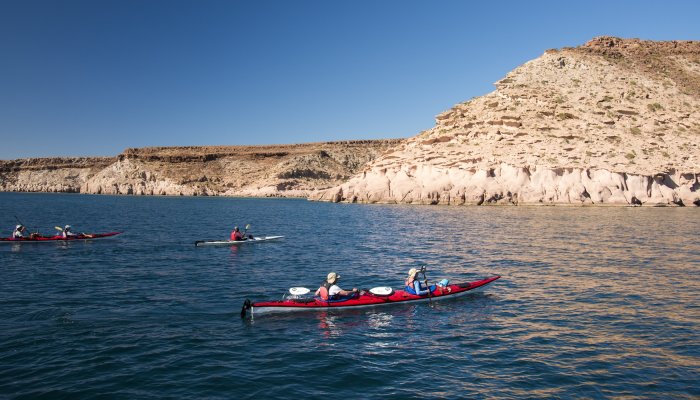
Loreto Bay National Park is a destination we explore on our Loreto based Baja sea kayaking itineraries, with time spent on land and in the water. It’s endlessly appealing for adventurous travellers - so much so that it was recently featured by the BBC as one of the top travel destinations for 2026.
The recent expansion of Loreto Bay National Park marks a significant milestone, not just for wildlife but for sustainable tourism and local livelihoods. In short, there’s never been a better time to visit!
In this article, we’ll delve into the history of Loreto Bay National Park and explain why its recent expansion matters - for local communities, marine life, and visitors to the region.

Early history: A unique place worth protecting
The waters surrounding Loreto have been important to both humans and wildlife for thousands of years. Indigenous communities (Cochimí, Guaycura, and Monquí) relied on the bay’s abundant fish, shellfish, and marine mammals long before Spanish colonisation began in the late 17th century.
The Monquí inhabited the coastal area around what is now Loreto, while the Guaycura lived in the area between Loreto and La Paz. To the north was the territory of the Cochimí, another semi-nomadic hunter-gatherer group that was decimated by the introduction of European diseases.
In 1697, Loreto became one of the first Spanish settlements in the Californias when it was founded by Jesuit missionaries. It served as the original capital of "Las Californias" and was an important base for colonial expansion through the region. As such, it has deep historical and cultural significance.
Ecologically, the area is also exceptional. Jacques Cousteau famously referred to the Gulf of California as “the world’s aquarium”. Loreto Bay sits at its heart.
Its waters support blue whales, fin whales, sea lions, manta rays, orcas, gray whales, and many dolphin species, not to mention a variety of reef fish and migratory seabirds. Many species depend on the region for breeding or feeding.

Creation of Loreto Bay National Park
Growing concern about overfishing, unregulated tourism, and habitat degradation led to the formal protection of the area in 1996. Loreto Bay National Park was established to safeguard both marine and coastal ecosystems, including coral reefs, mangroves, seagrass beds, and the islands offshore from Loreto.
From the beginning, the park stood out for its community-driven approach - something that it continues to uphold today. Local fishermen, tour operators, scientists, and conservation groups were all involved in designing the management plans, fishing zones, and tourism regulations. This cooperative model was designed to reduce conflict between stakeholders while encouraging sustainable use of Loreto Bay’s marine resources.
In 2004, Loreto Bay National Park joined the Ramsar list of Wetlands of International Importance. And just one year later, it was declared a UNESCO World Heritage Site, together with several other protected areas in the Gulf of California. These designations cemented the need to protect the bay for future generations.

Why was Loreto Bay National Park expanded?
Despite its protected status, ecological research shows that marine species don’t respect human-drawn boundaries. It should come as no surprise to learn that migratory routes, feeding grounds, and breeding sites in Loreto Bay were found to extend beyond the original park limits. An expansion was proposed.
Adding to the issue was the fact that Loreto Bay’s ecosystem was experiencing increased pressures from growing tourism, rising boat traffic, and the effects of climate change.
To address these challenges, Mexican authorities worked alongside scientists and local stakeholders to reassess the park’s boundaries. The goal was to create a larger, more connected ecosystem that would be better equipped to support marine life in the long term.
In 2023, two new protected areas - Nopoló Park and Loreto II Park - were created adjacent to Loreto Bay National Park. Additionally, the original marine park’s “no take” fishing zones were expanded to better protect fish breeding and nursery grounds.
Encompassing around 5,000 acres of the Sierra de la Giganta mountain range, Nopoló is a land-based park that was established to protect the area’s freshwater supply and prevent mining operations. In contrast, Loreto II Park was designed to preserve the coastal areas and enable better public access to the marine park, especially for non-motorized users such as sea kayakers.
Essentially, the expansion provides a bigger safety net for the sea while also benefiting sustainable fishing communities. Not only does it protect migratory whale corridors, but also spawning grounds for commercial fish species. It is also designed to safeguard deep-water habitats that are essential for biodiversity and climate refuges that are less affected by warming seas.

What this means for travelers to Loreto Bay National Park
For visitors, the expansion of Loreto Bay National Park greatly enhances the area’s appeal as a low-impact, nature-focused destination. Responsible whale-watching, kayaking, and eco-tours are still permitted (under strict guidelines), and the bay will be better equipped to handle visitor numbers in a sustainable manner.
With long-term conservation outcomes, divers, snorkelers, and kayakers visiting the area can (over time) expect healthier reefs and greater marine life encounters. More than ever, there is an emphasis on engaging with local guides, respecting wildlife regulations, and supporting businesses committed to responsible travel.
Here at Sea Kayak Adventures, we believe the expansion of Loreto Bay National Park reinforces its reputation as a slow-travel, eco-tourism destination, rather than a mass-tourism hotspot. It demonstrates how marine protection can succeed when scientific research, community interests, and tourism align to create a sustainable future where humans and wildlife coexist and flourish.