
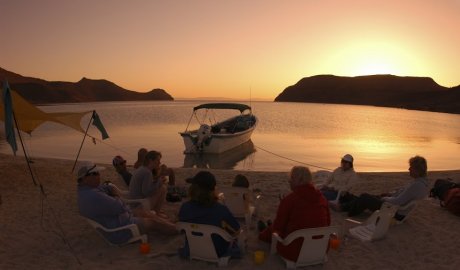
By Rob Mohle - Special to the San Luis Obispo Tribune June 7, 2002 Baja sunset It was a cold, dreary December day. The room was dark and the only sound was the gentle pitter-patter of rain. I stared vacantly at the gray computer screen deleting the junk email that had accumulated over the past week. Being an outdoors person, this was not my idea of a fun way to spend a Saturday. As I scrolled down the seemingly endless list one email suddenly caught my eye. "Imagine paddling your kayak with blue whales, hiking through forests of giant cardon cactus, swimming with colorful tropical fish and camping on remote beaches. Join Sea Kayak Adventures for seven days exploring the Sea of Cortez." Wow, this sounded just like the trip my wife Amie and I had been dreaming about.
We made our reservations and over the course of the next several weeks received all of the information outlining the trip details. Everything would be provided except for our clothing and swim gear. No previous kayaking experience would be necessary but everyone was expected to be in reasonably good physical condition. As an added attraction, we arranged in advance for an optional one-day whale-watching trip to Magdalena Bay on Baja's west coast. Our adventure began in the town of Loreto, just a short two-hour flight from Los Angeles International Airport. Unlike many other Mexico destinations, Loreto was quiet and uncrowded. It was the first Spanish settlement in Baja and the original capital. Just one block from our hotel was the oldest Spanish-era mission, Nuestra Senora de Loreto, founded in 1697. Early the next morning we boarded a comfortable tour bus for the whale-watching excursion to Magdalena Bay. From the narrow coastal plain, the winding two-lane highway climbed the towering volcanic escarpments of the Sierra de las Gigantas Mountains. The contrast of the red-hued desert colors against the vast blue water of the Sea of Cortez was spectacular. Our tour guide pointed out that the Sea of Cortez actually has three names: the Sea of Cortez, Gulf of California and its original name Mar Bermejo which means the "Sea of Sunset." Magdalena Bay is a large coastal lagoon, nearly 90 miles long and one-half to two miles wide. Each winter, hundreds of California gray whales migrate from the Bering Strait in Alaska to bear their young in these protected waters. Almost immediately after leaving the dock we spotted our first gray whales-a mother and calf pair. For the next three hours we saw literally hundreds of whales, some almost close enough to reach out and touch. Whales were sounding, breaching and even spy-hopping, an unusual behavior where the whale will hold its head 8-10 feet out of the water sometimes turning slowly to scan the horizon. Our seven-day kayak adventure began the next morning at Puerto Escondido a small harbor several miles south of Loreto. After introductions, Terry Prichard, owner of Sea Kayak Adventures and head guide for the trip gave a safety orientation and instructions on the basic skills of kayaking. After loading a-weeks worth of food, water and supplies for ten people into the four double and two single kayaks we were on our way. blue whale The first day we paddled to Isla Danzante, a small uninhabited island about three miles offshore. We made camp and spent the remainder of the day snorkeling and exploring the island. From towering cardon cactus that can grow up to 60 feet tall to the fragrant mesquite, the desert was in full bloom. Colorful hummingbirds dashed from flower to flower while an observant vulture circled cautiously overhead. Terry pointed out that the desert was unusually green due to a late season hurricane that dumped nearly 13 inches of rain last November. That's more rainfall than may normally occur during a ten-year period. Happy hour began a 5 o'clock followed by a delicious dinner of fish Veracruz, rice, steamed cauliflower, Chilean salad and a Pineapple Upside Down Cake cooked to perfection in a Dutch oven. I must say that every meal served during the entire trip was home-cooked and delicious. The next day we made another three-mile crossing to Isla Carmen where we spent the next three days. During the crossing a blue whale (the largest animal on earth) circled us several times, sounding repeatedly as it dove to great depths in search of krill, its primary food source. Magnificent frigate birds, osprey and squadrons of graceful pelicans soared overhead and the clear water was alive with brightly colored fish of all shapes and sizes. Isla Carmen is a spectacular island with jagged volcanic peaks, gorgeous white sand beaches and turquoise water. We spent our days paddling, hiking, snorkeling and tide pooling. It was late February and the temperatures during the daytime were in the mid-80s and at night in the comfortable 60s. The water temperature was about 70 degrees, a bit cool but okay with a wetsuit. On our final evening, Amie and I sat on the beach watching the sun set behind the Sierra de las Gigantas. The sea was calm and the air was still. The hollow, swishing sound of a spouting blue whale echoed across the brilliant crimson water. Now we knew the true meaning of Mar Bermejo. Rob Mohle lives in Shell Beach and is author of the book Adventure Kayaking, Trips from Big Sur to San Diego.