
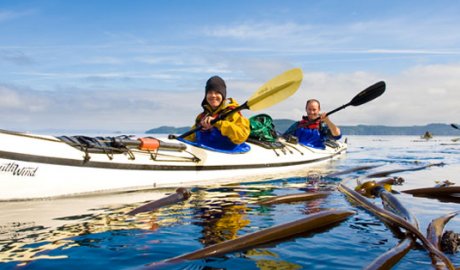
By Elle Andra-Warner - Special to Westjet's Inflight Magazine "Airlines" May 2002 It was one of those baby-boomer "I-can-do-anything" moments that landed me in a kayak, traveling through British Columbia's Johnstone Strait and Inside Passage.
In a surge of daring adventurousness, I signed myself up for a six-day summer kayak trip, momentarily ignoring the fact that I had never kayaked before.
Our paddling group consisted of eight novice urban adventurers, and three professional guides from Sea Kayak Adventures. We first gathered in July at Port McNeill on the northeast coast of Vancouver Island. The next morning, we slid our bare feet into slithery wet-suit booties and selected our kayaks. Everything needed for 11 people's complete self-sufficiency was packed into our six Sea ward kayaks. We had enough delicious food for a week of three scrumptious meals a day, and packed an unbelievable 40 duffle bags worth of gear into our six sea-crafts. After fitting ourselves into the kayaks, we fastened our waterproof kayak skirts, and pushed off into the Johnstone Strait. For the next two hours, we paddled close to the Vancouver Island shoreline, learning the necessary strokes and building up confidence for our pending kayak adventure. But the relaxed pace and light chatter belied the one subject on everyone's mind: How would our paddling skills hold up as we crossed the giant moving waters of Johnstone Strait? After a lunch at shore, we lined up side by side in our kayaks and fixed our gaze across the Strait to our beach campsite on Hanson Island, two nautical miles away. "Stay together as a group, paddle steady and focus on our landing site," guide leader Jacqueline Holmes instructed. "The guides will be out front and on both outer edges. Everyone ready? Let's go." It was raw, heart-racing adventure! Tense and apprehensive, I chewed gum vigorously as we pulled away from the comfort of the shore. The sun was shining and the water was relatively calm. No one spoke, and paddles rhythmically dipped through water reaching depths of 440 meters (1,500 feet). Two-thirds of the way across, someone shouted: "Paddle like crazy!" just before a churning rip tide crossed our path. Fueled by an instant adrenaline rush, I paddled ferociously, and soon we were through it and back into calmer waters. It took us an hour of steady paddling to complete the crossing. We hauled the kayaks to higher ground to secure them against the night's tide, and then set up our tents in the old growth forest just behind the beach. As the guides prepared a delicious dinner of salmon, tortellini, broccoli, salad, and peach cobbler, we sipped wine, nibbled hors d'oeuvres, and made toasts to each other on our first incredible day at sea. The next day, we visited the abandoned Kwakiutl village of Mamalilaculla on Village Island. We started the morning with a delicious breakfast of French toast, bacon, grapefruit, and fresh coffee. As we left our campsite an early morning fog settled over the water, and soon the silver-white mist gently enveloped the brightly colored kayaks. We floated silently through the mystical and surreal landscape, waiting for tide to come in. The route was almost five nautical miles, paddling the protected inland waterways of the Indian Islands. Along the way, we passed ancient pictographs on rock walls that marked sacred, Native burial grounds. An unscheduled stop at a rock outcropping (bathroom break) yielded a treasure of intertidal life. We kept busy examining rock crabs, clams, carpets of bladderwort, and a massive colony of acorn barnacles cemented to the surrounding rock. The sun was rippling along the water when we arrived at Mamalilucula and pulled our kayaks ashore. Seemingly out of nowhere, a boat landed to deliver the famous storyteller and guardian of the island, Tom Sewid. The grandson of a former Chief, Tom is the keeper of the island's Kwaitkul culture. Dressed in his Native regalia, he spoke to us from in front of weathered longhouse posts. Tom explained that Native people have inhabited the island for over 8,000 years. At one time, a summer village that harvested candle fish was located here. The harvest was made into prized eulachon oil, and stored in long kelp tubes for trade and winter use. With his easygoing style punctuated by big, friendly grins, Tom enthralled us with stories of Native history, totem poles, potlatches, and legends. Paddling back to our campsite, we were contemplative as we weaved through stunning scenery with the snowcapped mountains of Vancouver Island's Coastal Range in the distance. During another day's adventure, guide Laureen Macintoch led us on a mid-afternoon hike to Eagle Eye Lookout on West Cracroft Island. Located on a high ridge, it overlooks the world-renowned Robson Bight Ecological Reserve for whales on Johnstone Strait. It is a 2.5 kilometer trail, traversed through a rugged rainforest terrain of fallen timbers, sword ferns and giant trees. The magnificent panorama that greeted us at the lookout was worth every grueling step. At the very edge of the ridge, sitting on a weathered wooden stump searching for whales through binoculars, was David Briggs. The tanned, curly-haired researcher from California has lived on the ridge in a tent every summer since 1984, studying the whales and boat traffic. After welcoming us with a big smile, he enthusiastically shared some of his vast knowledge of whale society. "Whales have the most stable family groups. They are the only mammals in which all the offspring, even adult males, stay with their mothers for their entire lives. They help babysit the young, and when different family groups meet, there is much socializing. They are a dynamic society with strong social bonds. Each family has their own dialect, or set of calls, they use as part of their vocal repertoire." We remembered his words the next day when we experienced a close encounter with several whales on our return crossing to Vancouver Island. Midway through the Strait, guide Antonio Monzon sighted three large male orca dorsal fins coming towards us. We quickly rafted the kayaks together to appear as on large object on the whales' sonar, and positioned ourselves to face the oncoming whales. Jacqueline lowered a hydrophone into the water so that we could hear their vocalizations and sonar clicks. We waited as they continued their approach, maintaining a straight line toward our stationary kayak flotilla. About 100 meters (300 feet) in front of us, the whales began to surface and dive in close synchrony, finishing less than 15 meters (45 feet) to our right before continuing down the Strait. It was an awesome event that instantly became our new benchmark for adventure. Our final evening was spent amid beached logs at Blinkhorn Peninsula. We looked rougher than we did on our first night, and we sat around the evening campfire musing about our many adventures. We credited our trip's success to the skills and leadership of our excellent guides. They were dedicated professionals who cheerfully provided personalized attention, helping each of us find our individual comfort levels…and they were incredible cooks. In six days the expedition had honed us into modern-day explorers. We had paddled between three and four hours everyday and covered over 44 nautical miles. Amazingly, I never tired. Each day was an adventure in new and spectacular surroundings. Our spirits soared at the accomplishment. For me, the adventure was a journey of learning and challenge. It would be an oversimplification to say that I conquered the apprehensions of a novice kayaker. The fears were there every morning but I acknowledged them, then climbed into the kayak and paddled. If I had let these fears stop me, I would have missed the thrill of wilderness sea kayaking and an opportunity for personal growth. I took a risk and the rewards were priceless. On the last night, I gazed at the gorgeous sunset and reflected upon what had brought me there in the first place. After much contemplation, I vowed to act more often with my baby-boomer, "I can do anything" attitude, at heart. Would I do this again, You ask? Without hesitation, the answer is YES.